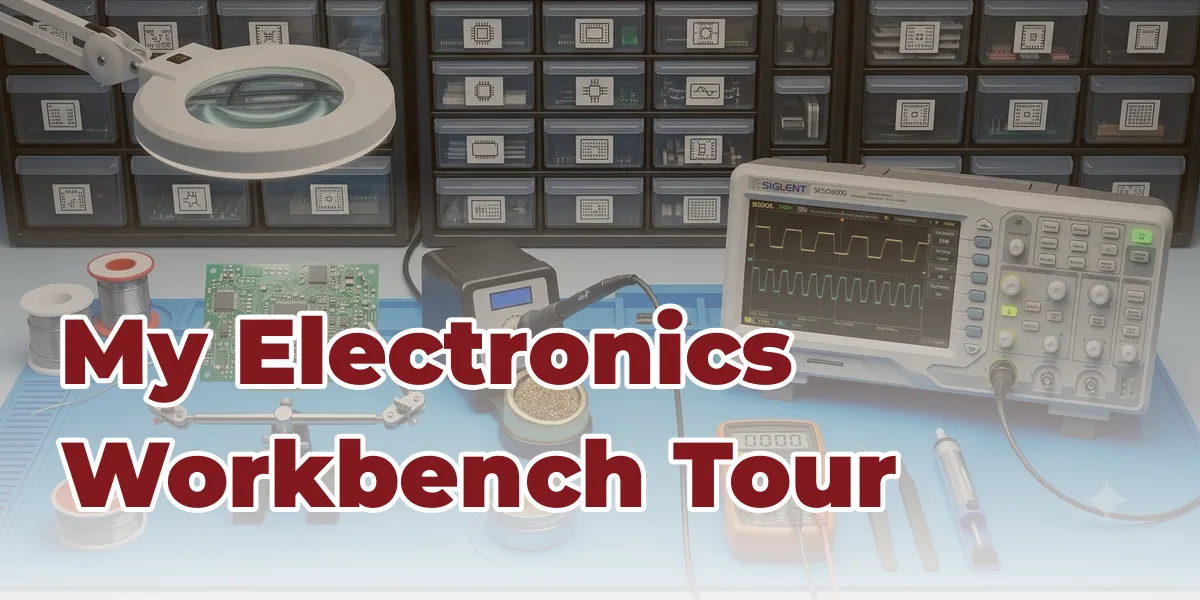
Every recommendation on this site comes from something that’s actually sat on this desk, so here’s the desk. Nothing exotic — this is a home hobbyist setup built up piece by piece as projects demanded it, not bought as a kit in one go.
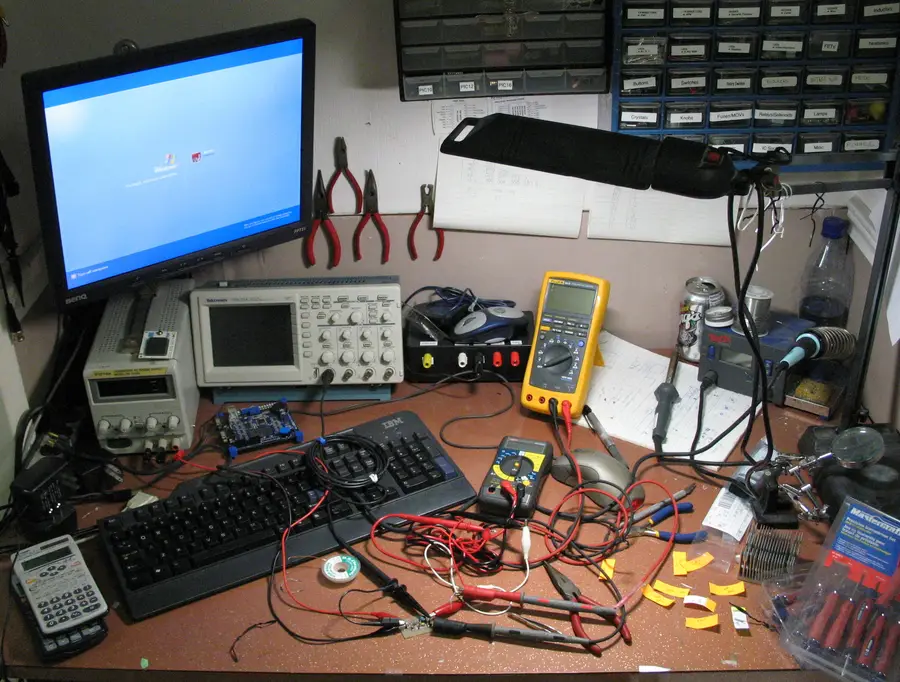
A home electronics workbench — mine looks a lot like this. Photo: James Bastow, CC BY-SA 2.0 (resized)
The boards
The board shelf is the part that’s grown the most. The Freenove Mecanum Wheel Car Kit , built around a Raspberry Pi Pico W, is what’s behind the line-following and light-tracing robot projects — four omnidirectional wheels and an 8×8 dot-matrix “face” that makes it easy to tell at a glance which mode it’s currently in. Next to it is a Diymore SX1262 LoRa V3 board that turned out, once I actually looked at the silkscreen, to be a genuine Heltec WiFi LoRa 32 V3 sold under a different storefront name — that’s the one running Meshtastic and backing the ESP32 DevKit pinout guide. A spare FREENOVE Raspberry Pi Pico 2 W sits in the drawer for whenever a project outgrows the original RP2040’s headroom.
Power corner
A Zolt 12W universal adapter , switchable across 3V–12V with a set of interchangeable barrel tips, covers most modules that need more current than a USB port comfortably provides — it’s what powers the Elegoo Fun Kit’s breadboard power rail. For anything battery-driven, an AEDIKO AA battery holder assortment and an AEDIKO 18650 holder assortment cover single-cell through four-cell configurations without having to solder a new holder every time a project’s voltage requirement changes, and a stack of DollaTek 9V battery clips turns a spare 9V battery into an instant barrel-jack supply for anything expecting an Arduino-style input.
Two multimeters live here, and they’re not redundant: a Draper digital multimeter for everyday continuity and voltage checks on the bench, and a Sealey MM20HV — hi-vis body, thermocouple probe included — that’s easier to spot when it’s been left somewhere it shouldn’t, and doubles as a way to check a soldering iron tip’s actual temperature rather than trusting the dial.
Soldering and prototyping
The soldering side is genuinely simple: an iron, solder, a mat, and a helping-hands stand, all covered properly in how to solder your first circuit — no need to repeat the full list here. What’s worth mentioning is what happens after a breadboard prototype works and needs to become something permanent. An ELEGOO perfboard kit (individually copper-ringed pads, not continuous strips — worth being precise about that distinction, since the two get sold under confusingly similar names) covers point-to-point soldered builds, and ehbn9 stripboard — genuine continuous-copper-strip Veroboard, confirmed from the listing photos rather than assumed from the name — is what I reach for when a circuit’s layout actually lines up with stripboard’s parallel-strip format well enough to save the cutting.
A Waveshare USB-to-TTL adapter , built around a genuine FT232RNL chip rather than a clone, earns its keep on anything that doesn’t have onboard USB-to-serial — a bare ATmega on stripboard, or a module that only exposes TX/RX. If you’re chasing a “board not detected” problem rather than reading about one, why won’t my ESP32 upload covers the driver side of this in more depth.
The parts drawers
An ELEGOO 37-in-1 sensor module kit is the single most-reached-for box on the shelf — not because every project needs all 37, but because when a project suddenly needs “some kind of tilt switch” or “a rotary encoder, cheaply,” it’s already there instead of being a two-day wait. Alongside it, an Eventronic heat shrink tubing kit (600 pieces across a dozen sizes) handles cable strain relief and insulating stray solder joints, and a pair of Draper soft-grip long-nose pliers does the fiddly bending and holding that side cutters and fingers both do badly.
Displays and audio
A Freenove I2C LCD 2004 module backs the I2C LCD pinout guide and is the display half of most status-readout projects — four lines is enough for a sensor reading and a label without needing to scroll anything. A Youmile PCM5102 DAC module handles anything that needs real audio out of a microcontroller rather than a piezo buzzer’s approximation of it.
What’s deliberately not here yet
No oscilloscope, no proper bench PCB mill, no reflow setup. Everything on this list earns its place because a specific project actually needed it, not because it looked good on a shelf — which is really the only buying rule that’s mattered so far. If you’re putting together your own version of this from scratch, the 10 essential tools every beginner should own is the honest starting subset of all this, not the full list above.

